Kids' teeth, from the first one on.
A child who has easy visits early grows into an adult who is not afraid of the dentist. That is the whole plan. Here is what happens at each age.
What happens at each age
| Age | At the visit | At home |
|---|---|---|
| By 1 | A look at the first teeth while your child sits on your lap. Ten minutes | Wipe or brush twice a day with a smear of fluoride toothpaste |
| 2 to 3 | The first real cleaning, and fluoride varnish | No bottle or juice cup in bed |
| 3 to 6 | Cleanings every six months. First X-rays when the back teeth touch | A pea of toothpaste. You do the brushing |
| 6 to 8 | Sealants on the first adult molars. A look at how the bite is growing | They brush, and you check |
| 12 to 13 | Sealants on the second molars | A mouth guard for sports |
| 16 to 18 | An X-ray to see where the wisdom teeth are heading | Floss, and fewer sodas |
A first visit, step by step
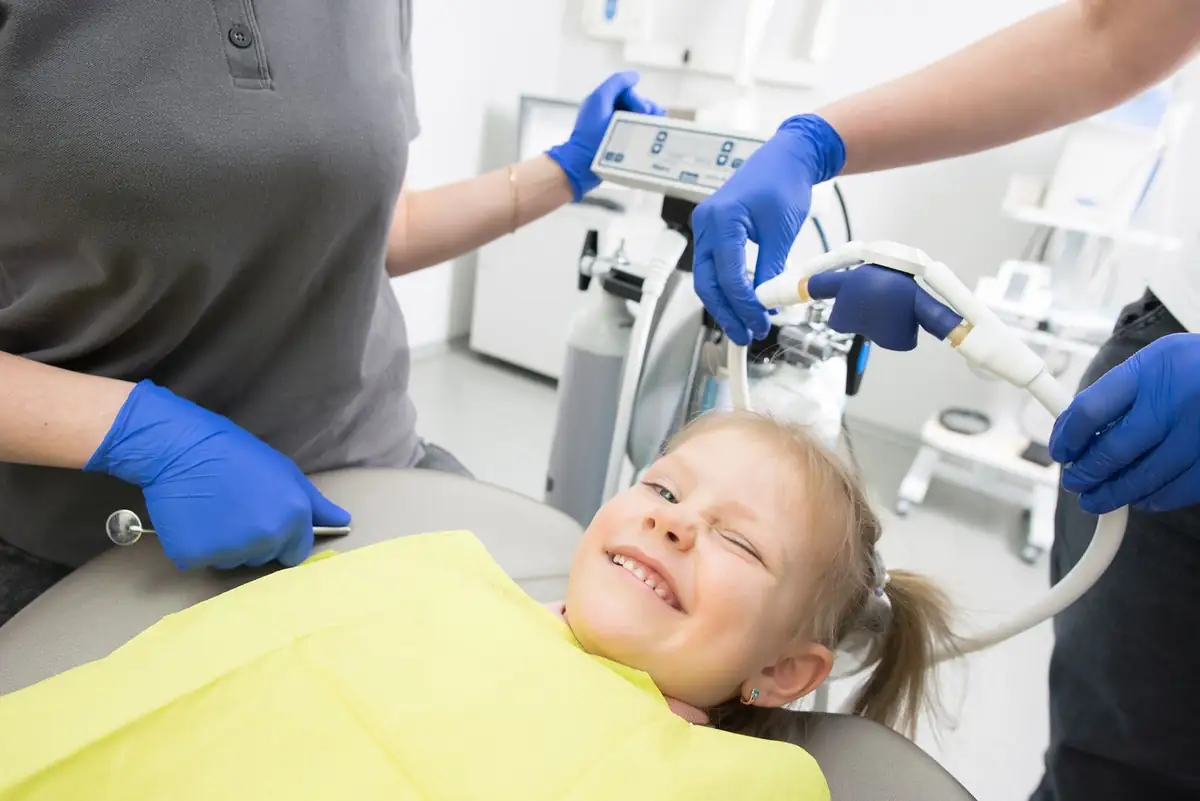
- A ride in the chair. Up, down and back. They work the button.
- Meet the tools. Mr. Thirsty the straw and the tickle toothbrush, on a fingernail first.
- Count the teeth. Out loud, with a mirror they can hold.
- Polish, if they are ready. They pick the flavor. If they are not ready, we stop there and call it a good day.
- The treasure box. One prize, chosen slowly.
Stopping cavities before they start
- Sealants. A thin coating painted into the grooves of the back teeth. No numbing, five minutes a tooth, $45, and most insurance pays for it.
- Fluoride varnish. Brushed on in ten seconds, twice a year.
- Water between meals. Juice, milk and sports drinks belong with food.
- Sticky snacks do more harm than candy that is eaten and gone. Fruit snacks are the worst of them.
- Baby teeth matter. They hold the space for adult teeth, and a bad one hurts as much as any tooth.
Things parents worry about
Thumbs and pacifiers
Most children stop by four with no harm done. If it is still going at five, we have gentle ways to help.
A second row of teeth
An adult tooth coming in behind a baby tooth is common. Wiggling usually sorts it out. If not, we help the baby tooth along.
Grinding at night
It sounds awful and is nearly always outgrown by six or seven. We check for wear at each visit.
Bumps, chips and knocked-out teeth
- A baby tooth knocked out: do not put it back. Press with a clean cloth and call us.
- An adult tooth knocked out: hold it by the top, rinse it, keep it in milk and come straight in. The first hour matters most.
- A chipped tooth: save the piece if you can find it. Most chips are smoothed or rebuilt in one visit.
- A tooth pushed out of place: leave it alone and call.
- A bitten lip or tongue: ice and pressure. If it is still bleeding after fifteen minutes, call.
Fitting it around school
- After-school times at 3:30 and 4:15, Monday to Thursday.
- One Saturday a month, kept for school-age children.
- Brothers and sisters can be seen side by side, so it is one trip.
- School and sports forms are filled in while you wait, at no charge.
- MO HealthNet for kids is accepted, along with the plans on our insurance list.
Before a first visit
Six small things that make it go well.
Asked by parents
When can my child brush without help?
About when they can tie their own shoes, usually seven or eight. Until then they have a turn and then you have a turn.
Are X-rays safe for children?
Ours are digital and use a very small dose. We take them only when there is a reason to, with a lead apron and collar.
A baby tooth has a cavity. Fill it or pull it?
Fill it, if it will be in the mouth for more than another year. Pulling it early can let the other teeth drift.
May I come back with my child?
Yes, at any age. Some children do better on their own after the first few visits, and we will tell you if we think so.
Book the first one early.
A first birthday is a good reminder. The visit takes ten minutes, and most babies sleep through half of it.