Concept design by Medeiros Web Design. Golden Holler Honey Farm is a fictional business.
How honey is made.
By about forty thousand bees to a hive, over a summer, a drop at a time. We mostly stay out of the way and lift heavy boxes.
From flower to jar
- 1. NectarA forager visits up to a hundred flowers a trip, and carries home a load nearly her own weight.
- 2. Passed alongHouse bees take it mouth to mouth, adding enzymes that turn it into the simple sugars of honey.
- 3. Fanned dryNectar is mostly water. The bees spread it in the cells and fan with their wings until it is thick.
- 4. CappedWhen it is ripe, each cell is sealed with white wax. That cap is how we know it is ready.
- 5. SpunWe slice off the caps and whirl the frames in a drum. The honey flies out, and the comb goes back to the bees.
- 6. Strained and jarredThrough a mesh to catch wax, into a tank overnight to let the bubbles rise, and into jars. Nothing else.
Bee arithmetic
| To make | It takes |
|---|---|
| One teaspoon of honey | The life's work of about twelve bees |
| One pound of honey | About two million flower visits, and 55,000 miles of flying |
| One pint jar | Three million flowers |
| One pound of wax | The bees eat about seven pounds of honey to make it |
| A summer worker's life | About six weeks. She wears her wings out |
| A hive at midsummer | 40,000 to 60,000 bees and one queen |
| A good year for one hive | 60 to 100 pounds for us, after the bees' share |
Who is in the hive
- The queen
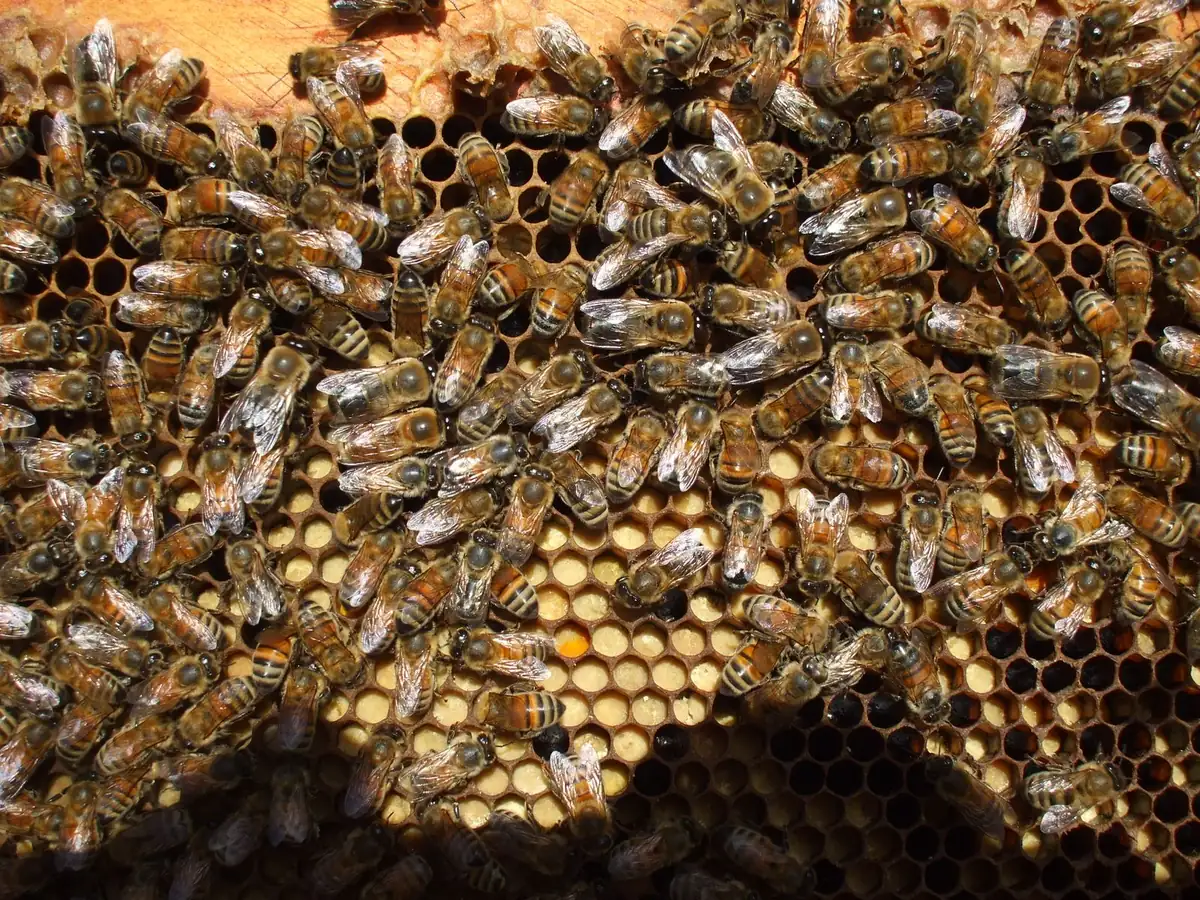
- One. She lays eggs, up to 1,500 a day in spring, and does nothing else. She can live three or four years.
- Workers
- All female, and nearly all the hive. They nurse, build, guard, clean and, in the last weeks of life, forage.
- Drones
- A few hundred males, in summer only. They do no work and cannot sting. In fall the workers put them out.
- The brood
- Eggs, grubs and pupae in the middle of the hive, kept at 93 degrees whatever the weather.
- The dance
- A forager who finds good flowers walks a figure of eight on the comb. Its angle and length tell the others where to fly.
Our year, month by month
| When | The bees | Us |
|---|---|---|
| January and February | Clustered round the queen, eating stored honey, shivering to make heat | Building frames, dipping candles and leaving them alone |
| March | The first pollen from maple and elm. The queen starts laying | A quick look on a warm day. Feeding any hive that is light |
| April and May | Building fast. Swarm season | Adding boxes, splitting strong hives and catching swarms |
| June | The clover flow | Stacking honey boxes. First pull at the end of the month |
| July and August | Wildflower flow, then a dry gap | Second pull. Shade and water for the hives |
| September | Goldenrod and aster. Raising the bees that will live through winter | Last pull. Leaving 60 pounds on every hive |
| October to December | Drones out, entrance guarded, cluster forming | Mouse guards on, windbreaks up, the stand stocked for Christmas |
The bee yards
- Three yards
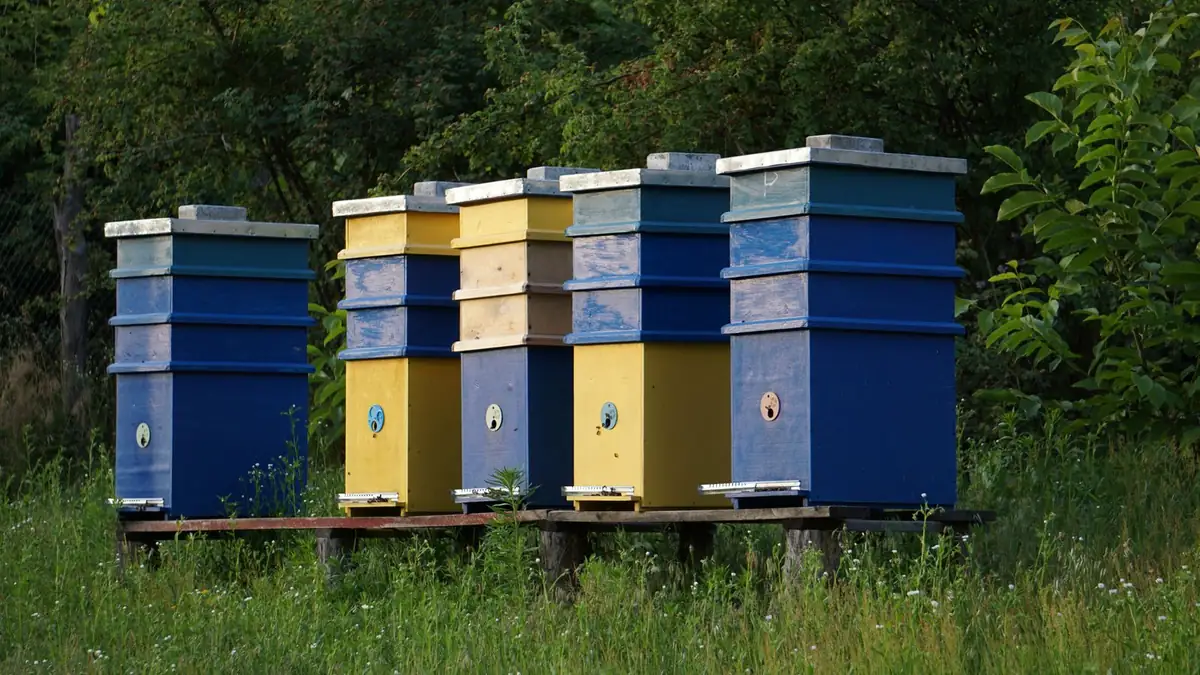
- Twenty hives each: one in the hollow behind the house, one on a neighbor's hay farm and one by the creek.
- Why spread out
- Sixty hives in one place would strip the flowers. Bees work best within a mile of home.
- Painted boxes
- Different colors help bees find their own door. Ours are whatever paint was left over.
- Facing southeast
- So the morning sun gets them flying early.
- Raised off the ground
- On stands, away from damp and skunks. Skunks scratch at the door at night and eat what comes out.
What we do not do
We do not heat it
Big packers warm honey to 160 degrees so it pours fast and stays clear on a shelf. That cooks off the smell and the taste.
We do not filter it fine
Our mesh stops wax and bee legs. Pollen goes through, which is how a lab can tell where honey came from.
We do not blend
Each pull is jarred as it came off. No mixing years, yards or other people's honey.
We do not feed for honey
Sugar syrup is only for a starving hive in early spring, months before honey boxes go on.
We do not take it all
Sixty pounds stays on every hive in September. A hive that winters on its own honey is stronger in spring.
Come and see
- The glass hive
- At the market stall every Saturday. Find the queen. She has a green dot.
- Open barn days
- The last Saturday of June and of August, 9 AM to noon. Watch frames being spun, and turn the crank.
- School groups
- We bring a glass hive, a suit to try on and honey sticks. Free for schools in Webster County.
- Suit up
- Ten people at a time can stand at an open hive with us on open barn days. Age eight and up. Suits provided.
- Allergic to stings?
- Stay at the barn. The bees there are busy with honey, not with you, but tell us.
Six ways to help bees from your own yard
Asked about the bees
Do you get stung?
A few times a week in summer. It stops swelling after the first few years. Gentle bees and slow hands help more than the suit.
Does taking honey hurt the bees?
Not if you leave enough. A hive stores far more than it needs in a good year. We take the surplus and leave their winter stores.
Are the bees dying out?
Honey bees are kept, so their numbers hold, but beekeepers lose a third of their hives most winters and work hard to replace them. Wild native bees are in more trouble.
What do bees do in winter?
They do not sleep. They hang in a ball round the queen and shiver their flight muscles to keep her warm, taking turns on the cold outside.
Now taste what they made.
Three honeys from three seasons, at the stand on Holler Road and the Saturday market.