Concept design by Medeiros Web Design. Echo Hollow Cavern is a fictional business.
350 million years in the making
How the cave got here, and what is growing in it.
Echo Hollow is a limestone cave, made by nothing more than rain and time. It is still being made. Every drip you hear on the tour is adding to something.
How it formed
- Sea
A shallow sea, 350 million years ago
Missouri lay under warm salt water. Shells and coral piled up on the bottom and were pressed into limestone hundreds of feet thick.
- Rain
Rain turns to weak acid
Rain picks up carbon dioxide from the soil and becomes a little sour. It seeps into cracks in the limestone and slowly dissolves it.
- Rooms
Cracks become rooms
Over about a million years the cracks widened into passages, then rooms. When the water table dropped, the rooms filled with air.
- Drip
Drip by drip
Now each drop that comes through the ceiling leaves a speck of mineral behind. That is all a stalactite is: specks, left one at a time.
What you are looking at
Your guide will point these out. Here is how to tell them apart.
Stalactites
They hang from the ceiling. Remember it by the c, for ceiling. Ours grow about an inch in a hundred years.
Stalagmites
They rise from the floor, under a drip. Remember it by the g, for ground. They are usually thicker and blunter.
Columns
A stalactite and a stalagmite that finally met. The tallest in the Cathedral Room is thirty feet.
Soda straws
Hollow tubes as thin as a pencil, with a drop of water hanging at the tip. Every stalactite starts as one.
Flowstone
A smooth sheet, like a frozen waterfall, where water runs down a wall and does not drip.
Draperies
Thin wavy curtains with brown and white stripes. Cavers call the striped ones cave bacon.
Please don't touch the formations. The oil on one fingertip can stop a stalactite from growing for good.
The cave in numbers
| Temperature | 60 degrees, every day of the year |
|---|---|
| Humidity | About 98 percent |
| Mapped passage | 3.2 miles, and cavers add a little each winter |
| Tour route | 1 mile, there and back |
| Deepest point on the tour | 200 feet, at Lost River |
| Tallest room | The Cathedral Room, nine stories |
| Steps | 104, down the natural entrance |
The bats, and how we protect them
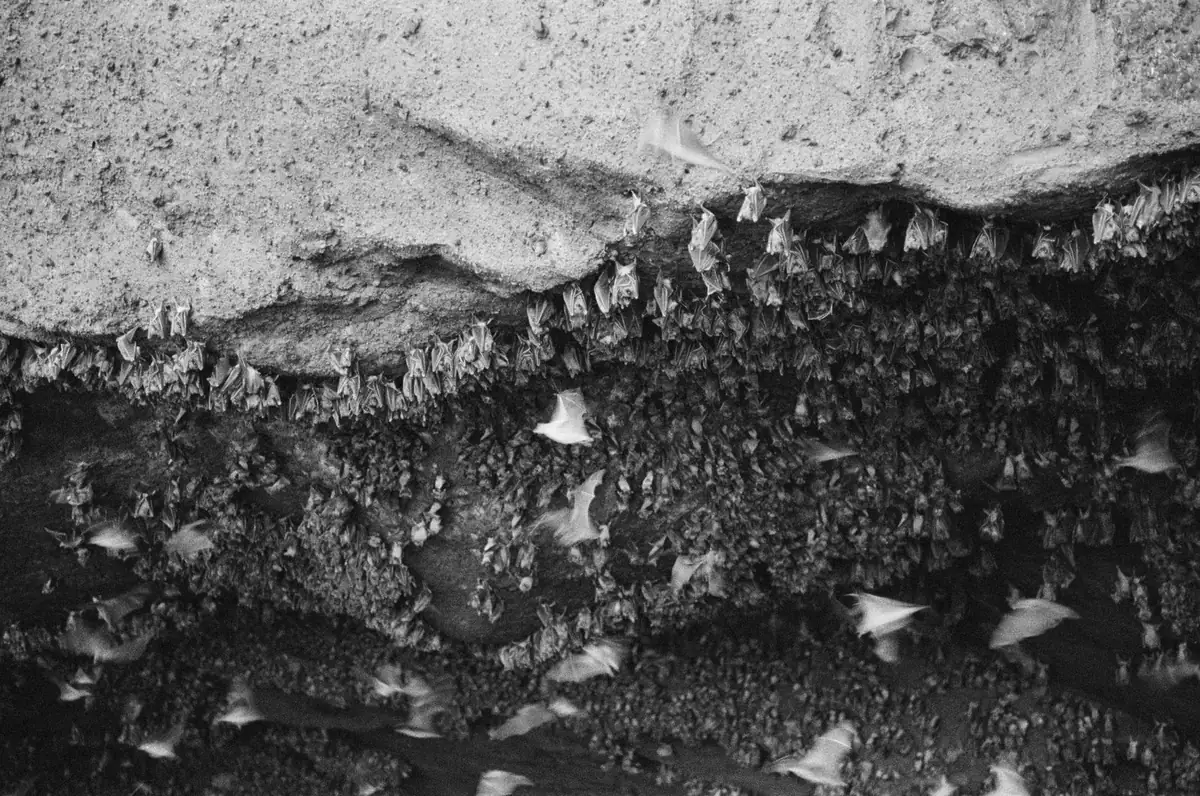
Gray bats roost near the entrance from April to September. They are an endangered species, and one bat eats thousands of insects a night over the creek.
- Tours go quiet for about fifty feet as we pass the roost, and guides keep their lights on the floor.
- Clean shoes, please. A fungus that kills bats travels on boots and clothes. If you have been in another cave, tell us, and step on the cleaning mat at the door.
- Bats do not fly at people. They find a mosquito in the dark by sound. They can find their way around your hair.
People in the cave
- Long before 1887. Soot marks on the ceiling near the entrance show that people sheltered here with fires.
- 1887. Two brothers hunting a lost calf climbed down the sinkhole with a lantern and a ball of twine. Their journal is in the ticket cabin.
- 1931. The first paying tours, by lantern, for 25 cents.
- 1958. Electric lights, the paved path and the 104 stairs.
- Today. Cavers still map new passage every winter, when the bats are asleep elsewhere.
The history is made up for this concept site.
Asked about the cave
Is the cave still growing?
Yes. Water still drips in most rooms, and where it drips, formations grow. You will not see it happen. An inch takes a century.
Has anyone been to the end?
Nobody knows where the end is. The river goes under a ledge at the bottom of the tour, and divers have followed it 400 feet farther.
Why is it always 60 degrees?
Rock holds the average temperature of the land above it. A few feet in, summer and winter cancel out.
Come and see it drip.
The Discovery Tour leaves every half hour. Bring a jacket, since 60 degrees feels cold after an Ozark summer afternoon.