Concept design by Medeiros Web Design. Level Best Foundation Repair is a fictional business.
Basements and crawl spaces
Waterproofing.
Water is behind almost every foundation problem we see. Keep it away from the house, and give what does get in somewhere to go.
Where the water comes in
| What you see | Where it is coming from | Usual fix |
|---|---|---|
| A puddle where the wall meets the floor | Ground water rising under the slab | Drain tile and a sump pump |
| A wet streak down from a crack | A crack in poured concrete | Resin injection |
| Damp along the top of a wall | Surface water: gutters, grading or a window well | Outside drainage first |
| Water coming up through floor cracks | A high water table | Drain tile and a bigger pump |
| A wet wall with nothing running | Vapor passing through block | A sealed wall liner and a dehumidifier |
| A musty smell and no water | Humidity | A dehumidifier, and seal the crawl space |
Start outside. It is cheaper
About a third of the wet basements we look at need nothing more than this. We say so.
The inside system
-
Drain tile
A trench is cut in the floor round the wall. Perforated pipe in gravel catches water before it reaches the slab, and the floor is poured back.
About $70 a foot
-
Sump pump
A sealed basin at the low corner, with a cast-iron pump that sends water outside, away from the house.
$1,400 installed
-
Battery backup
A second pump on a battery. Storms that flood basements are the ones that knock the power out.
$950
A whole basement, with drain tile, pump and a sealed wall, starts at $4,500.
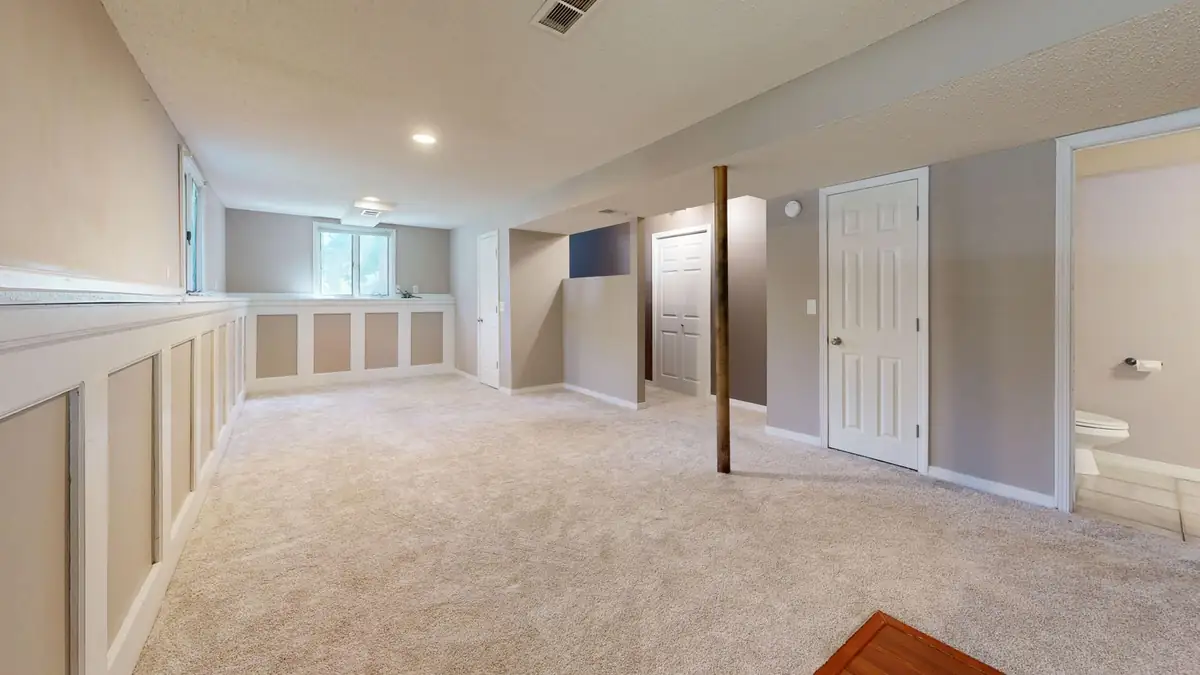
A basement you can finish
- Dry first, then build
- Carpet and drywall over a damp wall will grow mold inside a year.
- A wall liner
- A bright white sheet fixed to the wall sends any seepage down to the drain. Framing goes in front.
- Humidity under 50 percent
- A basement dehumidifier piped to the sump, so there is no bucket to empty. $1,300.
- Raised subfloor
- Dimpled panels under carpet keep it off the concrete.
- A water alarm
- A $25 sensor by the sump tells your phone if the water rises.
Crawl spaces
- Why it matters
- Up to half the air on the ground floor rises from the crawl space. If it is damp down there, it is damp upstairs.
- Signs
- Bouncy or cupped floors, a musty smell in closets, high summer humidity and pests.
- Encapsulation
- A thick liner over the dirt and up the walls, sealed at every seam, with the vents closed. $5,500 to $9,000.
- A dehumidifier
- Keeps the sealed space at 50 percent.
- Sagging floors
- Steel jack posts on concrete pads under the beams. $240 a post, and adjustable for good.
- Rotten wood
- Joists that have gone soft are sistered with new lumber before anything is sealed.
Looking after a sump pump
- Every spring
- Pour a bucket of water in the basin. The pump should start, empty it and stop.
- Check the outlet
- Outside, the pipe should be clear and pointing away from the house.
- Listen
- A pump that runs every few minutes in dry weather has a stuck switch or a leak feeding it.
- The battery
- Lasts about five years. The charger beeps when it is tired.
- The pump itself
- Seven to ten years. Replace it before it fails, not after.
Note these the next time it rains
It makes the inspection twice as useful.
Questions about waterproofing
Does waterproof paint work?
For a season. It holds back vapor, but water pressure behind the wall lifts it off. It also hides what the wall is doing.
Inside or outside waterproofing?
Outside means digging to the footing all round, which is costly with decks and drives in the way. An inside system does the same job from below.
How long does it take?
Two to three days for most basements. The floor can be walked on the next day.
Is there a warranty?
A lifetime dry-basement warranty on full systems, which passes to the next owner. Pumps carry the maker's three years.
Wet basement? Start with a look.
We check the outside first, and tell you if a downspout extension is all you need.