Septic · water lines · ponds · basements
Septic, ponds and digs.
The jobs where the work ends up underground. They need permits, inspections and an operator who has done them before.
How a septic system works
Three parts, and all three have to be right.
- The tank Usually 1,000 gallons of concrete. Solids settle, and liquid flows on.
- The distribution box It splits the flow evenly between the lines.
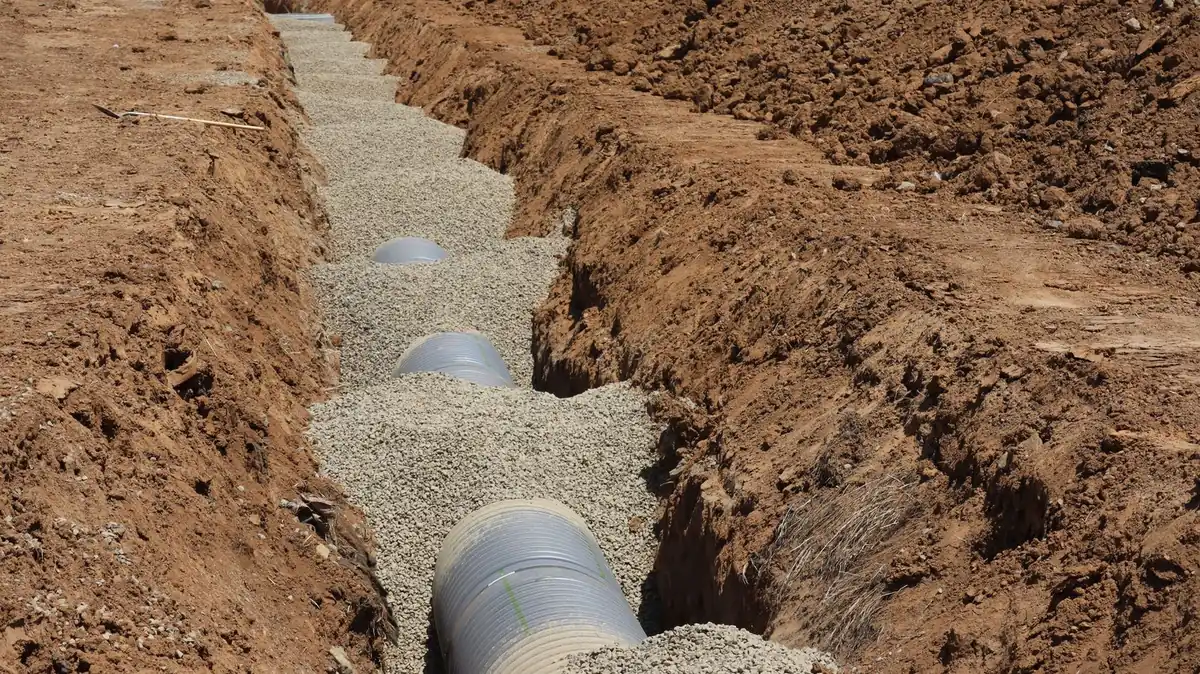
- The lateral field Perforated pipe in gravel trenches, where the soil does the cleaning.
- The soil It decides everything. A soil test tells us how much field the house needs.
Septic prices
With the permit, the soil evaluation and the inspection. Sample prices for this concept site.
| Job | Usual price |
|---|---|
| New conventional system | $7,500 to $11,000 |
| New system on poor soil, with a pump or a mound | $13,000 to $22,000 |
| Replace the lateral field | $4,500 to $8,000 |
| Replace the tank | $3,200 to $4,800 |
| Risers and lids to ground level | $450 |
| Find and dig up a lost tank | $250 |
Water, sewer and drain lines
- Water lines go thirty inches deep, below the frost.
- Sewer lines fall a quarter inch a foot, bedded in rock so they do not sag.
- Tracer wire goes in every plastic line, so it can be found again.
- French drains carry water away from a wet basement wall or a soggy yard.
- Culverts under driveways, sized by the ditch.
- Trenching is about $9 to $14 a foot, more in rock.
Farm ponds
A pond is a clay bowl. Without the clay it is a hole.
| Pond | About | Usual price |
|---|---|---|
| Stock pond | A quarter acre | $6,000 to $10,000 |
| Fishing pond | Half an acre, eight feet deep | $12,000 to $20,000 |
| One acre | With a spillway and an overflow pipe | $22,000 to $35,000 |
| Clean out an old pond | By the hour | $165 an hour |
- Test holes first. We dig three or four to find clay before we quote.
- A keyed dam. A trench of packed clay under the dam stops water seeping through.
- A spillway in solid ground, so a big rain does not go over the dam.
- Late summer is pond season, when the ground is dry enough to pack.
Basements and footings
Staked by the builder
We dig to the stakes, two feet wider all round for the wall crew.
Dug in a day
A typical basement is 250 to 400 yards of dirt.
Dirt sorted
Good fill is kept for backfill. The rest is hauled or spread.
Backfilled later
After the walls cure and the drain tile is in, in layers, with clean rock against the wall.
When we hit rock
- It is the Ozarks. About one dig in three finds ledge rock.
- We stop and call you before a hammer goes on the machine.
- Breaking rock is $210 an hour with the hydraulic hammer.
- Often the cheaper answer is to raise the floor a foot, or move the hole twenty feet.
- Broken rock makes good fill and rip rap, so it is not wasted.
Before a septic job
Questions about septic and ponds
How do I know my septic is failing?
Slow drains all through the house, wet ground or a smell over the field, or sewage backing up. Have the tank pumped and looked at first.
How long does a system last?
A tank lasts forty years or more. A lateral field lasts twenty to thirty if the tank is pumped every three to five years.
Will my pond leak?
Not if the test holes find clay. If they do not, we say so, and you have spent nothing.
Can you dig near my power line?
We call Missouri One Call before every dig, and hand dig within two feet of any marked line.
Start with test holes.
For a pond or a septic system, an hour with the backhoe tells us what the ground will do.